
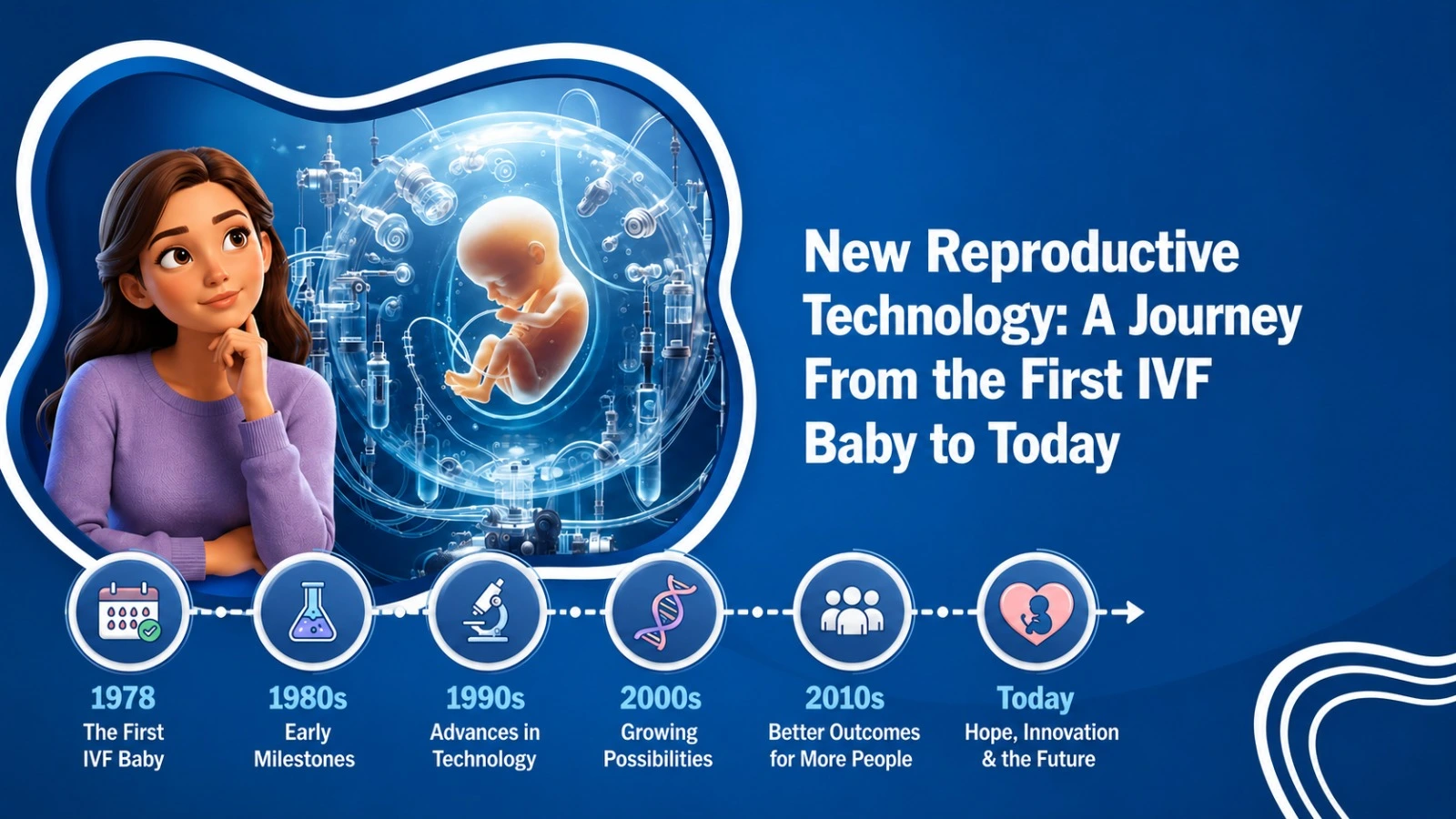
Every piece of new reproductive technology we see today did not appear overnight. It is the result of decades of patience, failed attempts, and quiet breakthroughs by scientists who refused to give up. Understanding this journey helps us appreciate just how far fertility science has come and how much thought goes into every new development.This blog takes you through that journey. Simple language. No complicated terms. Just the real story.
It All Started With a Question About Rabbits
Long before any human IVF baby was born, scientists were trying to understand something basic. Could an egg be fertilised outside the body at all?
In 1934, two researchers named Gregory Pincus and Ernst Enzmann attempted this with rabbit eggs. They did not succeed in creating a live birth, but their work proved something important. Fertilisation outside the body was scientifically possible.
Years later, in 1959, a scientist named Min Chueh Chang achieved the first confirmed live birth in mammals using this method, again working with rabbits. This was a major turning point. It showed that this idea could actually work, not just in theory, but in practice.
The Long Road Through the 1960s and 1970s
Between the 1920s and 1960s, scientists were also slowly understanding human hormones, like estrogen and progesterone, which play a key role in fertility. This understanding became essential groundwork for what was coming next.
In 1973, researchers at Monash University in Australia reported the first human IVF pregnancy attempt, though it did not lead to a successful birth at that time. Around the same period, several other attempts were made around the world, each one adding a small piece to the larger puzzle.
This stretch of years was filled with setbacks. But every failed attempt brought scientists closer to understanding what needed to change.
July 25, 1978 — The Moment Everything Changed
On this date, in Oldham, England, a baby named Louise Brown was born. She was the world’s first baby conceived through IVF, made possible by Dr Patrick Steptoe and Dr Robert Edwards.
This was not a small medical update. It was a complete shift in what was considered possible. For the first time, an egg had been fertilised outside the human body and successfully developed into a healthy baby. Robert Edwards was later awarded the Nobel Prize in Physiology or Medicine in 2010 for this groundbreaking achievement.
This single birth opened the door to everything that followed in new reproductive technology.
India’s Own Remarkable Chapter
What many people do not know is that India was part of this story almost immediately.
Just 67 days after Louise Brown’s birth, on October 3, 1978, a baby named Kanupriya Agarwal, who is lovingly called Durga, was born in Kolkata. She was India’s first IVF baby, and remarkably, only the second one in the entire world. This was achieved by Dr Subhash Mukhopadhyay, working alongside his team.
Sadly, his work was not properly recognised at the time, and he faced significant difficulties sharing his findings. It would take several more years before IVF was formally introduced and developed further in India. But his early achievement remains an important part of India’s contribution to global fertility science.
How the Technology Kept Improving
After 1978, IVF slowly moved from being an experimental procedure to becoming a recognised medical treatment. But it kept evolving constantly, step by step.
In the early years, success rates were quite low, often in single digits. Doctors initially relied on a woman’s natural monthly cycle, retrieving just one egg at a time. This changed when fertility medications were introduced to stimulate the ovaries, allowing multiple eggs to be retrieved in a single cycle. This single shift significantly improved the chances of success.
Over the following decades, several more pieces of new reproductive technology were introduced. Techniques like ICSI allowed a single sperm to be directly injected into an egg, helping many men with severe fertility challenges. Embryo freezing techniques improved dramatically, making frozen embryo transfers nearly as effective as fresh ones. Continuous monitoring tools, like time-lapse imaging, allowed doctors to study embryo development without disturbing it at all.
Where We Stand Today
Today, IVF is considered a well-established, evidence-based treatment used by millions of people worldwide. According to global estimates, at least 12 million babies have been born through IVF and related reproductive technologies since 1978.
Success rates today are dramatically higher than they were in the earliest years. For many younger patients, success rates per cycle are now close to 50%, a number that would have seemed unimaginable to the scientists working in the 1970s.
Every piece of new reproductive technology developed since then, including better lab equipment, improved genetic screening, advanced monitoring tools. These exist because of the foundation laid by those very first, uncertain attempts decades ago.
Why This History Matters
Understanding where new reproductive technology came from helps put today’s advancements into proper perspective. Every breakthrough we now consider routine was, at some point, a completely unproven idea that someone had the courage to test.
This history also reminds us that progress in fertility science has never been instant. It has always been the result of patient, careful research, building on the work of people who came before. As new reproductive technology continues to develop in the years ahead, this same spirit of careful, evidence-based progress is likely to continue shaping the future of fertility care.
Final Thoughts
The story of new reproductive technology is, in many ways, a story of human persistence. From early rabbit experiments to Louise Brown’s birth in 1978, to Durga’s birth in India just weeks later, to the advanced techniques used in clinics today & each step was built on the one before it.
Knowing this history gives a deeper appreciation for how far fertility science has travelled, and how much careful work continues to go into every new advancement that helps people build their families today.
Frequently asked questions (FAQs)
1. Who was the world’s first IVF baby?
Louise Brown, born on July 25, 1978, in England, through the work of Dr Patrick Steptoe and Dr Robert Edwards.
2. Who was India’s first IVF baby?
Kanupriya Agarwal, known as Durga, born on October 3, 1978, in Kolkata, just 67 days after Louise Brown.
3. Why did early IVF have lower success rates?
Early IVF relied on a single naturally occurring egg per cycle. Fertility medications were introduced later to improve the number of eggs retrieved.
4. How many babies have been born through IVF worldwide?
According to global estimates, at least 12 million babies have been born through IVF and related technologies since 1978