
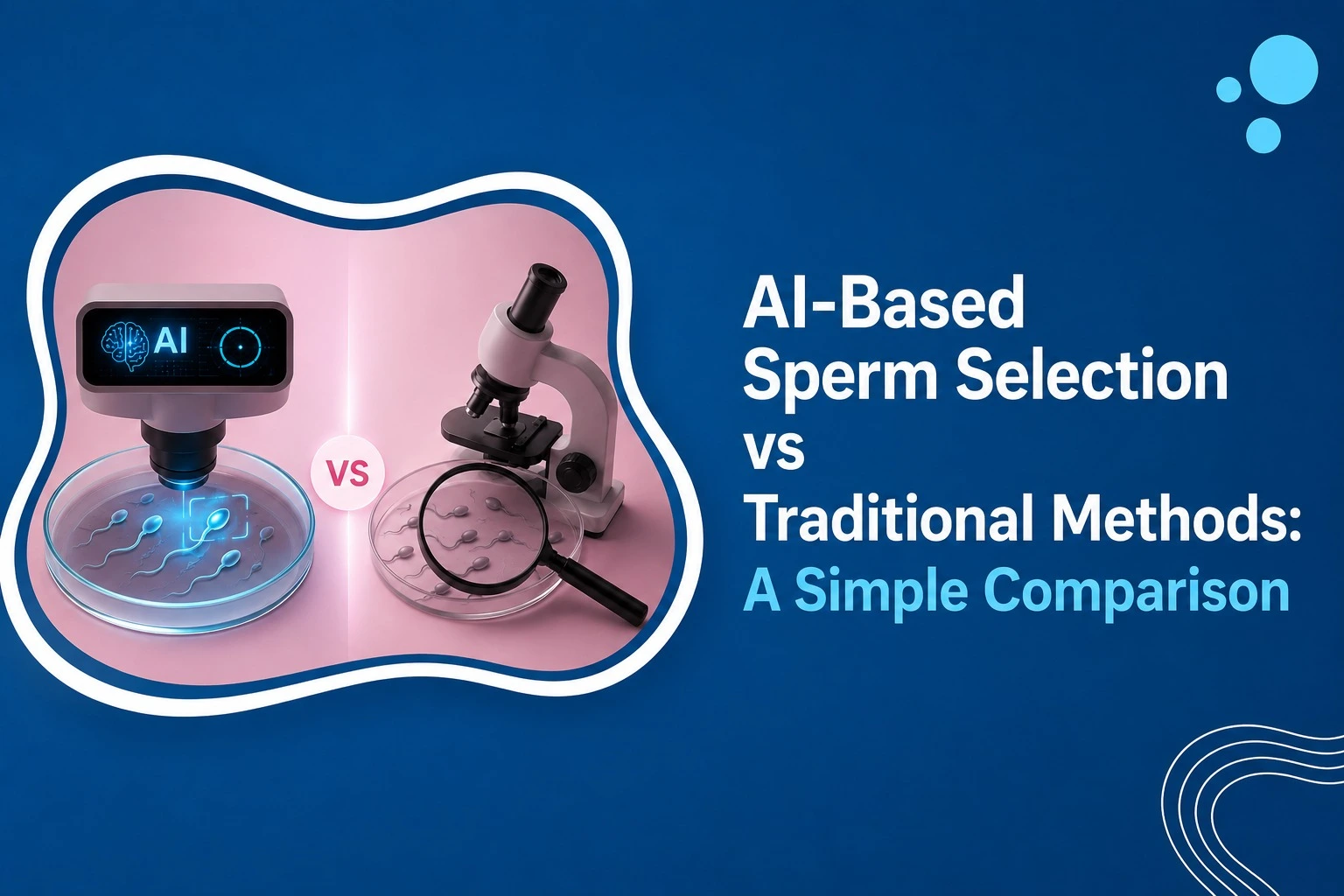
Choosing the right sperm for fertilisation is one of the most important steps in IVF and ICSI. For years, this has been done one way. Now, AI based sperm selection is being introduced as a newer option.
So how do these two approaches actually compare? Let’s break it down. Simple language. No confusing terms. Just an honest, clear comparison.
How Traditional Sperm Selection Works
Traditional sperm selection has been used for decades. It usually starts with a method called density gradient centrifugation. This separates sperm based on their movement and density.
After that, an embryologist looks at the sperm under a microscope. They check things like shape, movement, and overall structure. Based on this, they choose the sperm most likely to fertilise the egg successfully.
This method works. It has helped millions of families. But it depends heavily on the embryologist’s own judgement. And human judgement, even when highly trained, can vary a little from person to person.
How AI Based Sperm Selection Works
AI based sperm selection takes a different approach. Instead of relying only on visual judgement, it uses computer software trained on large amounts of sperm data.
The AI looks at the same things an embryologist would check. Shape. Movement. Structure. But it does this in a more consistent, repeatable way every single time. Some newer AI tools can even study unstained, living sperm in detail. This is something traditional methods often cannot do without affecting the sperm.
The goal is simple. Reduce the natural variation that comes from manual selection. And give doctors more reliable information to work with.
What Does the Research Actually Say?
This is where honesty matters most. So let’s look at real findings from recent studies.
A 2025 study published in Reproduction and Fertility found that an AI model showed a strong correlation with existing semen analysis methods. It performed well in identifying healthy sperm shape, without needing to stain the sample first.
Another 2025 study, published in Reproductive Biology and Endocrinology, looked at AI-based sperm selection during ICSI specifically. The results were balanced and honest. Embryos created using AI-selected sperm showed comparable outcomes to those using traditional methods. However, the study also found something genuinely interesting. AI-based selection showed a more noticeable advantage in cases involving compromised egg quality, while showing limited extra benefit in donor egg cycles.
A separate pilot study, presented in 2025 at a major reproductive medicine conference, found that sperm selected using AI software led to a significantly improved embryo utilisation rate, while the actual embryological outcomes remained comparable to conventional methods.
So, Is One Method Actually Better Than the Other?
Right now, the honest answer is this. They are more similar than different.
Multiple 2025 studies have found that AI based sperm selection produces results that are comparable to traditional methods in most cases. It is not yet shown to dramatically outperform traditional selection across the board. What it does offer is more consistency, and in certain specific situations, a small additional advantage.
This is actually a reassuring finding, not a disappointing one. It means traditional methods remain reliable and well-proven. And it means AI based sperm selection is a genuinely promising addition, without needing to be oversold as something it is not yet fully proven to be.
Where AI Based Sperm Selection May Help the Most
Based on current research, this technology appears to offer slightly more benefit in specific situations.
When egg quality is already compromised, AI-assisted selection has shown a more noticeable advantage. When consistency matters greatly across many cycles, AI naturally performs the same way each time, unlike manual selection, which can vary slightly. And, when sperm samples are difficult to evaluate, especially with low sperm count or unusual characteristics, the added layer of detailed analysis can be genuinely useful.
These are not guarantees. They are simply patterns researchers have noticed so far, and more long-term studies are still ongoing.
What This Means for You
If you are exploring IVF or ICSI, here is the simple takeaway. Traditional sperm selection remains a well-established, reliable method, with decades of real-world success behind it.
AI based sperm selection is a newer tool being studied carefully. Early research shows it performs comparably overall, with some specific advantages still being explored. It is not a replacement for a skilled embryology team. It works alongside their expertise, adding another layer of consistency to the process.
The best approach is to simply ask your fertility team directly. Ask what method they use, and why. A good clinic will explain this clearly and honestly, without overselling either option.
Frequently asked questions (FAQs)
1.Is AI based sperm selection proven to work better than traditional methods?
Not dramatically better overall. Recent studies show comparable outcomes, with AI offering more consistency and some advantage in specific cases.
2.Does AI replace the embryologist in sperm selection?
No. AI supports the embryologist’s decision. The final selection still involves the medical team’s expertise.
3.Is traditional sperm selection still considered reliable?
Yes. It remains a well-established method with decades of proven results.
4.Does AI based sperm selection help every patient equally?
Not exactly. Some studies show slightly more benefit in cases with lower egg quality, and less added benefit in donor egg cycles.
5.Is this technology widely used in clinics today?
It is still being studied and gradually introduced. It is not yet considered standard practice everywhere.